
Chasing Stars by Boris Groysberg 2010
Chasing Stars The Myth of Talent and the Portability of Performance By Boris Groysberg
Executive Summary
“Chasing Stars” is a major contribution to talent management literature. Based on extensive research by Harvard Business School Professor Boris Groysberg, the book challenges the idea that top performers can easily transfer their success from one organization to another.
The Core Thesis
The central argument: star performance is not mainly about individual talent—it’s about the fit between the individual and their organization. Companies spend billions recruiting star performers, but Groysberg’s research shows most stars experience significant performance declines when they change firms.
Key Statistics
- Research Scope: 1,000+ star analysts at Wall Street investment banks
- Interviews Conducted: 200+ interviews with analysts and executives
- Study Duration: Multi-year longitudinal study
- Performance Decline: Immediate and lasting decline for most star “switchers”
- Exception Rate: Only specific conditions allow stars to maintain performance
Groysberg conducted one of the most comprehensive studies of talent portability, focusing on Wall Street equity research analysts. Their performance is objectively measured and publicly ranked.
Research Background & Methodology
The Harvard Business School Study
Groysberg conducted one of the most comprehensive studies of talent portability, focusing on Wall Street equity research analysts. Their performance is objectively measured and publicly ranked.
Research Design
- Sample Size: Over 1,000 star analysts
- Industry: Wall Street investment banking
- Data Type: Performance rankings, employment histories, interviews
- Time Period: Multiple years of longitudinal data
- Methodology: Quantitative analysis + 200+ qualitative interviews
Why Wall Street Analysts?
- Objective Performance Measures: Analysts ranked annually by Institutional Investor magazine
- High Mobility: Significant talent movement between firms
- Clear Star Definition: “Star” status is publicly recognized and measurable
- Similar Work: Comparable work across firms
The Discovery Process
The research team expected stars to maintain excellence regardless of where they worked, based on the belief that talent is individual and portable. However, data showed star analysts who changed firms suffered an immediate and lasting decline in performance. Their earlier excellence depended heavily on their former firms’ resources, cultures, networks, and colleagues.
Key Findings: The Portability Problem
The Central Finding
Star analysts who change firms suffer an immediate and lasting decline in performance. This challenges the assumption that drives billions in recruiting spending.
Performance Trajectory After Switching
- Before Move: Star performer (top ranked)
- Year 1 After Move: Significant decline
- Year 2-3 After Move: Continued decline or stagnation
- Year 4-5 After Move: Rarely returns to star status
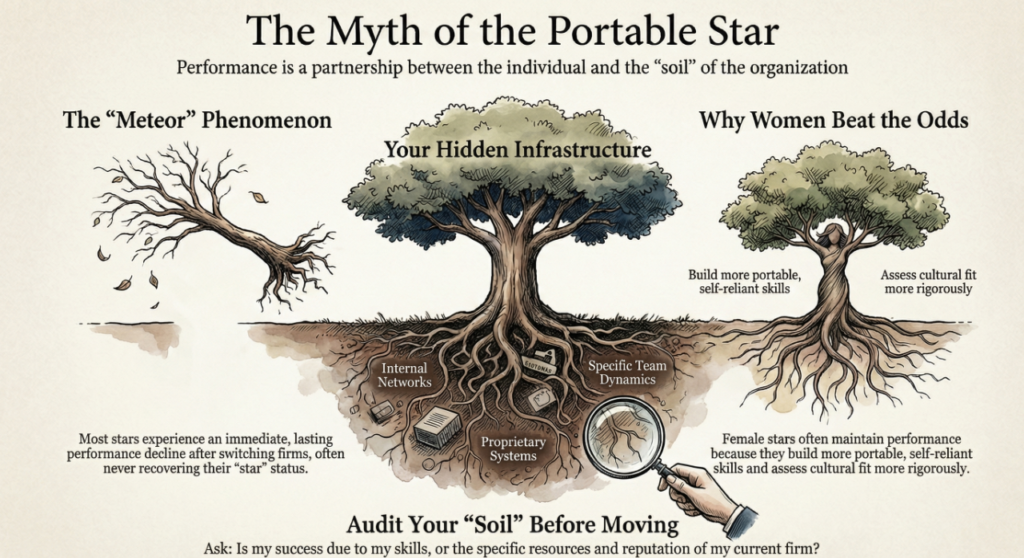
The “Meteor” Phenomenon
Most stars who switch firms become meteors, quickly losing luster in their new settings. Star performance often burns bright in one context but fades rapidly in another.
Why Companies Keep Chasing Stars
- Visible Track Record: Proven performance history
- Competitive Pressure: Fear of losing stars to competitors
- Short-Term Thinking: Immediate credibility boost
- Myth of Portability: Belief that talent travels with the individual
Why Star Performance Declines After Moving
The Organizational Context Factor
Success is driven by the organization and internal networks. Individual performance is more dependent on organizational context than most realize.
Five Critical Resources Stars Leave Behind
- Firm-Specific Resources: Proprietary data, systems, tools (High impact)
- Organizational Culture: Ways of working, values, norms (High impact)
- Internal Networks: Relationships with colleagues, support staff (Very high impact)
- Team Dynamics: Collaboration patterns, trust, communication (Very high impact)
- Firm Reputation: Brand value, market position, client relationships (High impact)
The Hidden Infrastructure of Success
Star performance depends on invisible infrastructure that doesn’t travel with the individual:
- Support Staff
- Information Systems
- Colleague Collaboration
- Client Relationships
- Management Support
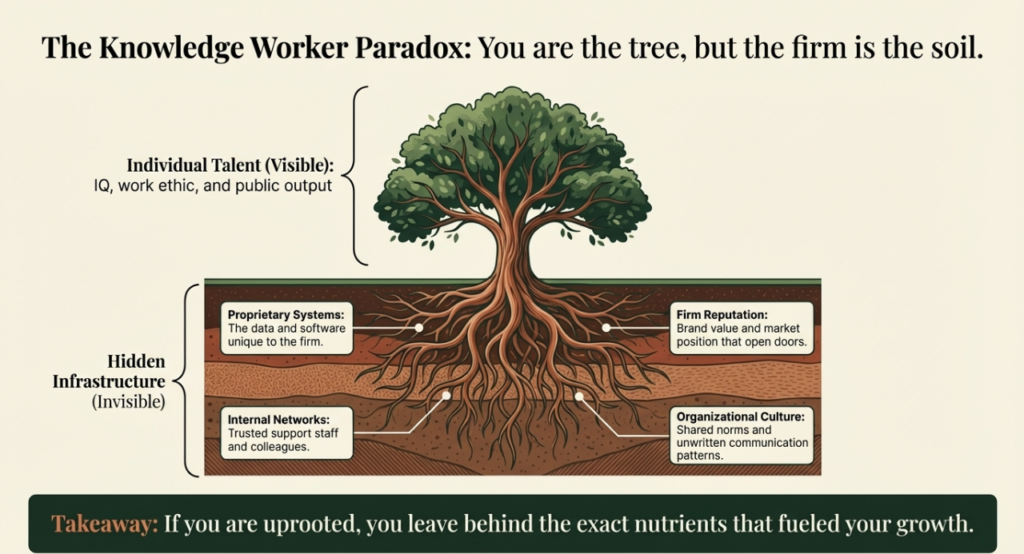
The Knowledge Worker Paradox
Professionals are seen as free agents, able to take their talents anywhere. Reality: much individual performance depends on organizational context.
The Exceptions: When Stars Do Succeed
Groysberg identified specific conditions under which stars can maintain or improve performance.
Exception 1: Moving With Their Teams
Stars who move with their teams perform significantly better than those who move alone.
- Preserves critical working relationships
- Maintains collaboration patterns
- Transfers team culture and dynamics
- Reduces adjustment period
Example: When an entire research team moves, the star analyst maintains access to their support network.
Exception 2: Switching to Better Firms
Stars who switch to better firms perform better than those who move to equivalent or worse firms.
- Access to superior resources
- Enhanced firm reputation
- Better support infrastructure
- Stronger market position
Exception 3: Strategic Job Changes
Stars who make strategic, well-planned moves perform better than those who make reactive or opportunistic moves.
- Thorough due diligence
- Clear understanding of role and expectations
- Alignment with career goals
- Cultural fit assessment
Exception 4: Female Stars
Female star performers often continue to thrive when they move from one organization to another.
Gender Differences in Talent Portability
The Female Star Advantage
Female stars perform better after changing jobs than their male counterparts.
Why Women Perform Better After Moving
- Self-Reliance: Women rely more on their own abilities
- Network Limitations: Less access to male-dominated networks, so they develop portable skills
- Selectivity: More selective about job changes
- Cultural Fit Assessment: Examine more factors before moving
- Preparation: Prepare more thoroughly for transitions
What Women Consider Before Moving
- Number of other women in the organization
- Objective performance measurement
- Cultural fit
- Career development opportunities
- Work-life balance
Implications for Organizations
Companies should give women opportunities, as their positive results in new settings may surprise many.
The Talent Development Dilemma
Many companies rely more on recruiting star players than developing their own talent, sometimes spending more on recruiting than on internal development.
The Strategic Balance
- External Hiring (Stars): Immediate credibility, proven track record; high cost, performance risk, cultural disruption
- Internal Development: Cultural fit, loyalty, lower cost; takes time, requires investment
Key Recommendations for Organizations
- Focus on Internal Development: Develop and retain internal talent for sustainable advantage
- Use External Hiring Strategically: Complement internal development, hire stars only when specific conditions are met
- Determine Optimal Hiring Ratio: Ideal internal/external hiring ratio, tipping point toward internal talent development
- Create Star-Supporting Infrastructure: Invest in resources, build strong internal networks
- Retention Over Recruitment: Retain existing stars, keep top performers engaged and supported
The Competitive Advantage
Companies that develop and retain internal talent have an edge over those constantly searching elsewhere.
Implications for Individual Careers
For Star Performers Considering a Move
- Organizational Resources: What resources at my current firm enable my performance?
- Network Dependencies: Which relationships are critical to my success?
- Cultural Fit: How well does the new firm’s culture match my working style?
- Team Movement: Can I move with key colleagues or support staff?
- Firm Quality: Is the new firm better, equivalent, or worse than my current one?
Career Management Strategies
- Understand Your Success Factors: Identify what enables your performance, distinguish between portable and firm-specific skills
- Build Portable Capabilities: Develop skills not dependent on specific organizational resources, cultivate external networks and reputation
- Plan Moves Strategically: Don’t make reactive or purely financial decisions, consider long-term trajectory
- Negotiate for Resources: Secure commitments for support staff, systems, resources
- Consider Team Moves: Explore opportunities to move with key colleagues
The Reality Check
Both star performers and companies should appreciate that it is often the organization that makes the individual successful.
The Five Drivers of Star Performance
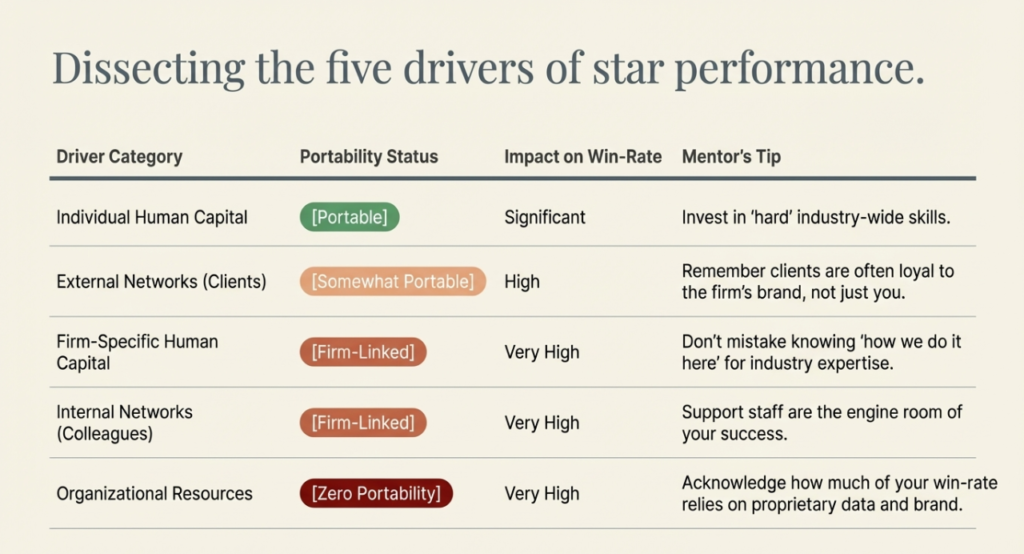
Groysberg’s research identifies five key factors:
1. Individual Human Capital: Skills, knowledge, experience, talent (Medium portability, significant impact)
2. Firm-Specific Human Capital: Knowledge of firm systems, processes, culture (Low portability, very high impact)
3. Organizational Resources: Tools, data, support staff, infrastructure (No portability, very high impact)
4. Internal Networks: Relationships with colleagues, management, support functions (Low portability, very high impact)
5. External Networks: Client relationships, industry connections, reputation (Medium to high portability, high impact)
Key Insight: If any factor is weak, overall performance suffers. Individual talent alone is insufficient.
Strategic Recommendations
For CEOs and Senior Leaders
- Audit current talent strategy (High priority, Month 1)
- Assess internal/external hiring ratio (High priority, Month 1-2)
- Invest in internal development programs (High priority, Months 2-6)
- Create star retention initiatives (High priority, Months 3-6)
- Build supportive infrastructure (High priority, Ongoing)
For HR and Talent Management
- Develop internal talent pipelines (High priority, Months 1-12)
- Create realistic star hiring criteria (High priority, Months 1-3)
- Implement cultural fit assessment (High priority, Months 2-4)
- Design onboarding for external hires (High priority, Months 2-6)
- Track performance of star hires (High priority, Ongoing)
For Hiring Managers
- Evaluate why candidate was successful (High priority, During hiring)
- Assess resource requirements (High priority, During hiring)
- Plan integration support (High priority, Before start date)
- Set realistic performance expectations (High priority, First 90 days)
- Monitor and support transition (High priority, First 12 months)
For Individual Professionals
- Audit personal success factors (High priority, Before job search)
- Identify portable vs. firm-specific skills (High priority, Before job search)
- Research target firms thoroughly (High priority, During job search)
- Negotiate for necessary resources (High priority, During offer stage)
- Plan integration strategy (High priority, Before starting)
Key Takeaways & Action Items
The Bottom Line
- Talent is not primarily portable—star performance depends heavily on organizational context
- Most stars decline after moving—immediate and lasting performance drop is the norm
- Exceptions exist—team moves, better firms, and female stars perform better
- Internal development wins—companies that develop talent internally have sustainable advantage
- Organization makes the star—often the organization makes the individual successful
For Organizations: Do’s and Don’ts
Do
- Invest in internal talent development
- Create supportive infrastructure for stars
- Assess cultural fit carefully
- Retain existing top performers
- Use external hiring strategically
Don’t
- Rely primarily on external star hiring
- Assume stars will perform regardless of context
- Hire stars based on track record alone
- Ignore retention in favor of recruitment
- Make star hiring a default strategy
For Individuals: Do’s and Don’ts
Do
- Understand what enables your performance
- Build portable skills and networks
- Research potential employers thoroughly
- Negotiate for necessary resources
- Consider team moves when possible
Don’t
- Assume your success will travel with you
- Depend entirely on firm-specific resources
- Make moves based primarily on compensation
- Accept roles without support infrastructure
- Move alone without transition planning
Final Thoughts
“Chasing Stars” represents a fundamental shift in how we think about talent management. The research is clear: individual performance is deeply embedded in organizational context.
The Ultimate Insight
“If we get over the myth of talent portability, we can start to focus on developing the best and brightest within our organizations.”
The Strategic Imperative
By nurturing homegrown talent, companies will boost their prospects for long-term success.
The Personal Imperative
Both star performers and companies should appreciate that it is often the organization that makes the individual successful.
About the Author
Boris Groysberg is the Richard P. Chapman Professor of Business Administration at Harvard Business School. He teaches courses on corporate leadership, talent management, and human capital strategy.
Recommended Next Steps
- Read the full book for deeper insights and case studies
- Audit your organization’s talent strategy against the findings
- Assess your internal/external hiring ratio
- Invest in internal development programs
- Track performance of star hires to validate findings in your context
This summary covers the key concepts, research findings, and practical implications from “Chasing Stars.” For complete details, data analysis, and additional case studies, refer to the original book.
The Myth of the Portable Star: Why Your Success is More Than Just You
1. The Hook: The Allure of the “Rainmaker”
Think about your ultimate career goal. For many of us, it’s to become the “star performer”—the legendary rainmaker who can walk into any office, in any city, and instantly start winning. We love the idea that talent is like a suitcase: something you own, pack up, and carry from one company to the next without losing a shred of its value.
But I want to warn you: this “suitcase” model of talent is a dangerous assumption that has derailed countless high-flying careers.
To understand the reality of success, we have to look at the work of Boris Groysberg, a professor at Harvard Business School. Groysberg conducted a massive, landmark study of over 1,000 Wall Street equity research analysts to see if “star power” is truly portable. What he found wasn’t just surprising—it fundamentally changed how we understand professional achievement. The data reveals that while you might be the one doing the work, your success is rarely yours alone.
2. The Reality Check: The Harvard Findings
When Groysberg tracked these high-performers as they switched firms, the results were startlingly consistent. Instead of hitting the ground running, most stars experienced an immediate, precipitous drop in their output.
This decline follows a predictable Performance Timeline:
- Year 1: The Immediate Decline. Upon switching firms, stars almost immediately suffer a sharp drop in their performance rankings.
- Years 2–3: Stagnation. Instead of bouncing back as they “adjust,” these performers usually see their results remain flat or continue to struggle.
- Year 5: The “Permanent Blip.” Most strikingly, by the fifth year at a new firm, the majority of stars still have not returned to the ranking they held at their previous company.
The “So What?” for the Young Professional: This brings us to what Groysberg calls the Knowledge Worker Paradox. We like to think of ourselves as “free agents” with skills that can be applied anywhere, but the data proves we are actually deeply “rooted.” High performance is fragile and context-dependent. If you are excelling today, it isn’t just because of your IQ or work ethic; it is because you are in a specific ecosystem that allows those traits to blossom.
When you ignore this context, you risk becoming a “meteor” in the professional sky.
3. The Meteor Metaphor: Bright, Brief, and Gone
Groysberg uses the “Meteor” phenomenon to describe the typical trajectory of a high-profile hire. A meteor enters the atmosphere with incredible brilliance, but that brightness is fleeting—it eventually burns out.
“Stars burn bright in one context, but when they move, their brilliance fades fast. It’s like watching a shooting star—spectacular for a moment, then gone.”
Why do firms keep making the mistake of hiring these meteors? Often, it’s for a quick boost in credibility or a desperate attempt to gain market share. But there is a massive difference between a Shooting Star (temporary brilliance tied to a former employer’s systems) and Lasting Success (performance that is sustainable because it is properly supported). To avoid the meteor trap, you must learn to see the “soil” you are currently planted in.
4. Tree vs. Soil: Understanding Hidden Infrastructure
As your mentor, I want you to internalize this analogy: you are the Tree, and your organization is the Soil. You can be the strongest oak in the forest, but if you are uprooted and dropped into a desert, you will wither. Your success relies on “hidden infrastructure”—the tools, culture, and people that provide your nutrients.
To help you audit your own “portability,” look at these five drivers of performance:
The 5 Drivers of Performance
| Driver Category | Portability Status | Mentor’s Tip |
| Individual Human Capital (Skills, knowledge, education) | Portable | Invest in “hard” skills that are valuable across the entire industry, not just your current desk. |
| Firm-Specific Human Capital (Knowledge of internal systems/processes) | Firm-Linked | Don’t mistake knowing “how we do it here” for being an industry expert. |
| Organizational Resources (Proprietary data, software, brand reputation) | Firm-Linked | Be honest: how much of your “win rate” is actually due to your company’s powerful brand name? |
| Internal Networks (Relationships with support staff and mentors) | Firm-Linked | Build deep relationships with support staff early; they are the “engine room” of your success. |
| External Networks (Client and industry relationships) | Somewhat Portable | Remember: many clients are loyal to the firm’s reputation, not just your individual personality. |
While the odds seem stacked against a move, the research did find a few specific “survival strategies” used by those who beat the decline.
5. The Exceptions: How to Beat the Odds
While most stars fade, Groysberg identified four scenarios where professionals successfully maintained or even improved their performance:
- Moving with Teams: By bringing trusted colleagues along, stars preserve their “home field advantage.” They keep the communication patterns and trust that make them efficient.
- Moving to “Better” Firms: This isn’t just about prestige. Moving to a firm with superior resources (better data, better support, better tools) can provide a performance boost that outweighs the loss of your old network. The higher-quality “soil” actually enhances the tree.
- Strategic Preparation: Winners do their homework. They don’t move for the paycheck; they move for the cultural fit. They research whether the new firm’s working style matches their own before they ever sign an offer.
- The Female Advantage: Remarkably, women often thrive after a move where men fail. Because women are historically excluded from “old boys’ clubs” (male-dominated insider networks), they are forced to build skills that are truly portable and rely on objective performance measures. This makes them more resilient and selective—they don’t move unless they are certain the new environment can support their specific needs.
6. The Learner’s Blueprint: Building Your Own Constellation
This research shouldn’t discourage you from ever changing jobs; it should empower you to make smarter, more calculated moves. Success is a partnership between your talent and your environment.
The New Professional’s Checklist When you sit down for your next interview or evaluate a job offer, use this checklist to see if the “soil” is right for you:
- [ ] Audit Resources: Does this firm have the specific data and proprietary tools I need to maintain my current output?
- [ ] Assess Internal Networks: Who are the key “enablers” (support staff/admins) here? Will I have access to them immediately?
- [ ] Research Cultural Fit: Is performance measured objectively here, or is success based on “who you know”?
- [ ] Evaluate the “Soil”: Is this firm’s brand and infrastructure actually better than where I am now, or am I just chasing a title?
- [ ] Negotiate for Resources: Beyond salary, have I negotiated for the support staff, specific budget, or tools required to succeed?
The Final “So What?” As you navigate your career, remember that real success isn’t just about being a star; it’s about finding the right sky to shine in. Before you look for a new firm, ask yourself if you’ve fully utilized the resources where you are. In the end, the grass isn’t always greener on the other side—it’s greener where you water it. Focus on growing your roots as much as your branches.