Selling With By Nate Nasralla 2024
How to building champion relationships to close enterprise B2B deals through internal influence.
Part 1: Making the Mental Shift
Prologue: Just Like That
- Here’s the hard truth: sales reps are almost never in the room when deals are actually won or lost.
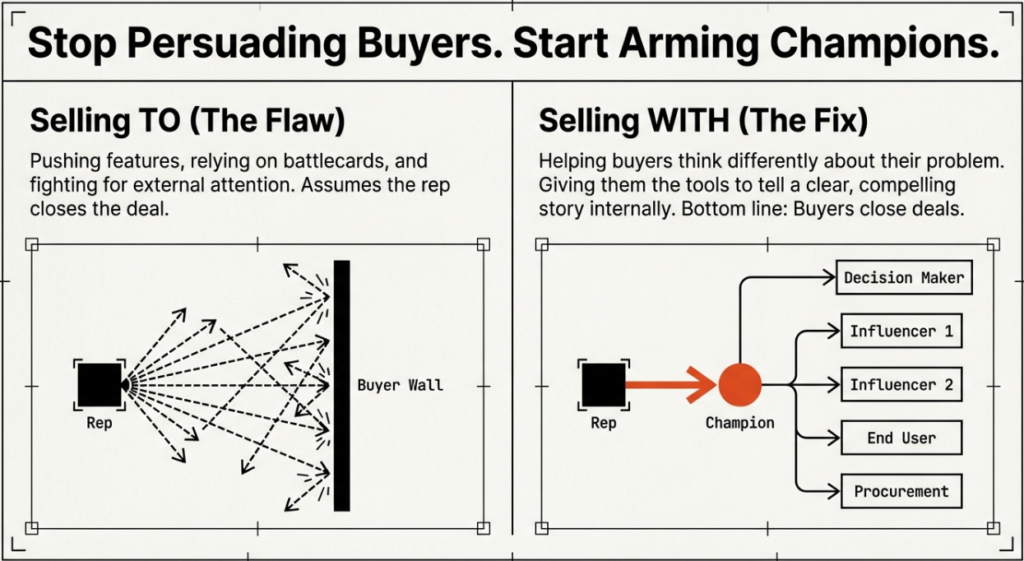
- The best sales reps don’t sell TO buyers. They sell WITH them. Think of it this way — you’re helping your buyers think differently about their problem. You’re giving them the tools to tell a clear, compelling story that gets their whole team on the same page about what to do next. Bottom line? Sales reps don’t close deals. Buyers close deals.
- Your real job? Create and enable committed champions for every single deal in your pipeline.
- Most deals stall because there’s no urgency and momentum fades. The buying team never truly aligned on the problem or how important it really was.
- Champions are the glue that holds together three different groups in a deal:
- Daily users (the people actually using the tool)
- Key stakeholders (think SLIP — security, legal, IT, procurement)
- Decision-maker(s) (the folks who sign off)
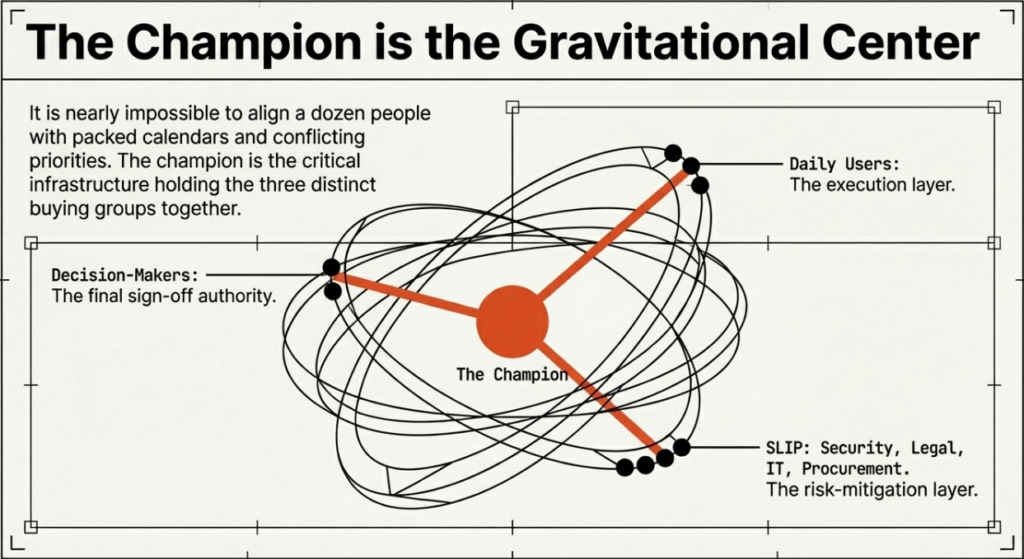
No Champion, No Deal
- Let’s be honest — it’s nearly impossible to get a dozen people aligned when everyone has their own priorities and packed calendars. You need a solid champion. Sometimes you need more than one.
- Here are a few simple tests you can try:
- First, switch things up. End a conversation with, “Hey, would you mind if I shoot you a quick text if I have a question before our next call? I’m also happy to set up a Slack Connect channel if that’s easier for you.”
- Second, ask your champions to walk you through their buying process. Let them explain it in their own words.
- Third, give them action items. The best ones “add value” to the process and give you a clear yes-or-no way to see if they followed through. Examples: calling a customer reference, sharing data for your business case, or adding comments to an internal memo (we’ll dive deeper on this later).
- Fourth, train them. Help them understand how to sell internally for you.
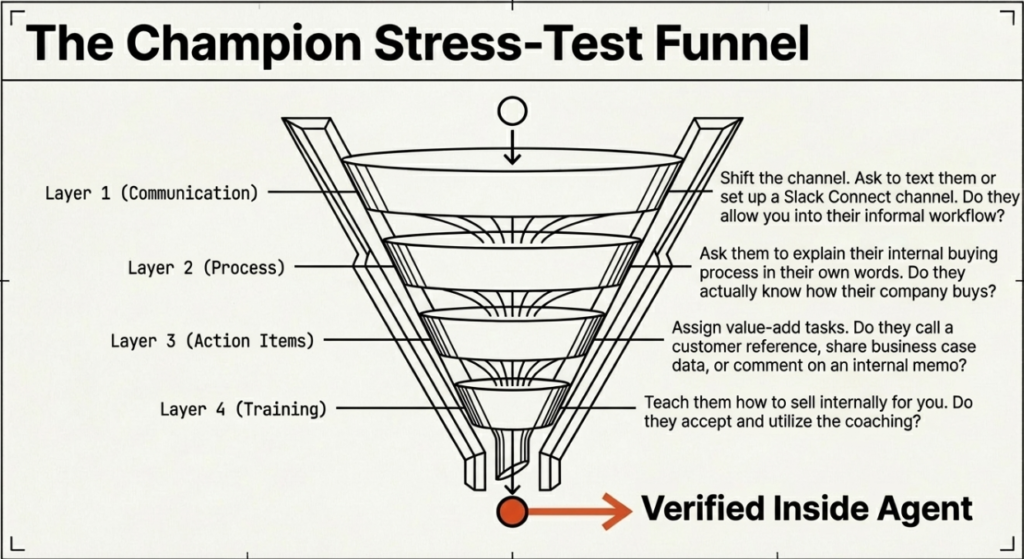
Life Inside the Enterprise
- When you feel like you have no idea where you stand in the sales cycle, here’s the thing — your buyers probably don’t know either. To figure it out, they’ll likely book another internal meeting to discuss next steps and push for more feedback.
- Ideas never stand alone — they’re always tied to who’s delivering them. This is especially true in corporate environments.
- Here’s an important distinction: Issues only become problems when they’re blocking a priority. Otherwise, they’re just distractions. Not real problems.
Part 2: Designing the Buyer’s Journey
Building Your Pipeline Around Buying Behavior & Bias
- You never want to negotiate terms until you’re confirmed as the provider of choice. Period.
- Make sure your buyers set the pilot goals — not you.
- Deliver short-term wins during long sales cycles. Keep them engaged.
The Buyer’s Emotional Journey
- Start by asking yourself: How do I want my buyer to feel after this meeting, call, or email?
- We started asking our prospects: “Based on what you’ve seen, on a rough scale of one to ten — with ten being a perfect fit — how do you feel about working together?” This way, we could step in before things dipped. “Oh, a six? Why not five? … and what do you think getting to an eight might look like?”
Account Maps That Actually Win Deals
- Enterprise account mapping is really about designing how internal communications flow. Who needs to say what, to who, and when, to keep a deal moving forward.
- Here’s an example of the end account map you’ll be creating:
- Create a short profile for each contact with three bullets:
- Buying role. Again, I like color-coding by role.
- Current priority. What project is absorbing most of their time and attention right now?
- Key metrics. How are they evaluated? What company-level metrics do they impact?
- Reach out to partners and noncompetitive sales teams in your network who have sold into the account before. How did their sales process unfold? Consulting firms who have worked with the account are a goldmine of information, too.
- Remember, an account map is dynamic — not static. You’ll want to revise and update your map as you receive new inputs, your deal evolves, and it grows hotter or colder.
- Use forwardable emails when possible to ensure the sender is internal, not external. Internal emails are always prioritized over external emails. For example, instead of the sales rep sending the proof-of-concept results back to Tina with Gina cc’d, we’ll have Gina forward it to Tina, cc’ing the sales rep.
- If you notice a contact who stays silent, fades into the shadows, or ducks meetings, shine a light on them. Are they a power user of another software? Are they opposed to making a change?
- Build a bridge between business units from up high, not down low.
- To keep your deal moving, you’ll need communication flowing from someone who oversees both business units — the CRO, for example.
- Not every communication that moves your deal forward is an email or a call. What standing meeting agendas, or Slack and Teams channels, will the buying team use to share feedback?
Part 3: Think & Sell Differently
The Discovery Roadmap
- Asking better questions starts by realizing that curious sales reps aren’t enough — we need to create curious buyers.
- Good sales questions are measured by the level of curiosity they spark in your buyer.
- Qualification is account research. It happens at the start of the cycle to search for a potential fit with a product based on straightforward questions and known answers.
- Discovery is continuous throughout the sales cycle. It searches for meaningful problems and uses open-ended questions that require reflection and collaboration.
- On the topic of seeking to understand, try asking: “What’s something about this issue others you’ve shared it with don’t always seem to understand?”
- On the topic of priorities and ranking problems, ask: “I’m guessing [relevant project or problem] isn’t your full-time focus. Which projects would you prioritize over this one in your team’s next meeting agenda?”
- To create greater buying confidence and conviction, ask: “It seems like you’re getting by with [current process] okay. So why not hold off and come back to this project later?”
- To start developing a business case, ask: “Does your team have a standard structure or template for sharing new projects with everyone?”
- To find the requirements your buyers are already sold on, ask: “What do you believe must be true of a solution for it to work in your case?”
- On creating — not allocating — budget: “I don’t imagine you have extra budget for software just sitting around. It typically has to be created. So if we assume for a minute that you feel it’s worth the effort, how would you go about creating a budget for this?”
- To reveal the personal motivator tying a potential champion to your deal, ask: “Everyone tracks their work a bit differently. For example, I use OKRs. Are you personally working toward any certain metrics this year?”
- “Who from your team would share the most meaningful feedback with us?”
- No buyer wants to feel interrogated. They want to have a conversation. Pepper your meetings with questions as they flow naturally, in between sharing your point of view and customer stories to break up the flow. Never pour them out in a constant flood.
The Art of Crafting Internal Narratives
- Too much branding is counterproductive. The best color scheme is “camouflage.” It uses your buyers’ branding, not yours, to create materials that look like they could have been created inside of the buying committee.
- We assign far greater value to the things we build than what we buy or others build for us.
- There’s a major problem with sellers using battlecards. Every time you use one, you’re fighting a feature war, and top sellers do all they can to avoid feature wars.
How to Avoid Screwing Up Executive-Level Meetings
- Generally, they’re thinking about:
- Seismic shifts in an industry
- Looming and existential risks
- Massive, untapped opportunities
- Executive meetings always go off-agenda. Be ready for that.
- To be sure you can hold their attention, fill in this sentence: “Most people believe __________, but actually, ___________.”
- To discover if you’re truly aligned on priorities, frame up a choice for them: “Are there certain projects this discussion will need to take a backseat to?”
- The most likely outcome [of an executive meeting] is an internal referral. That referral is worth its weight in gold because it brings priority with it. “Do this, because it matters.”
- A good question for the end of [an executive] meeting: “How would you like us to keep you updated?”
Multithreading & Navigating Dysfunctional Buying Groups
- The question [your champion] and other buyers ask themselves is, “Am I better off in a meeting with you than without you?”
- Your champion can’t introduce you to someone they don’t know. So, it’s your job to come alongside them with research and outreach to new contacts who need to be involved. Invitational language for this might sound like: “[New contact], I was hoping to include you in a conversation about [internal priority] with the [business unit] team next week. Would it make sense for you to weigh in on this? If this doesn’t sound relevant for you now, all good — [your business unit] tends to be closest to this topic at first, so I thought I’d reach out.”
- It costs your champion something to sell with you — their social capital — regardless of whether or not your deal gets done.
- Getting to the decision-maker is a myth. There’s never one decision-maker because of all the people who can say no. While there may be a single “economic buyer” who signs the contract, everyone in the committee who can say no is a decision-maker.
- If you find that the buying committee keeps expanding, it’s a sign of dysfunction. You’re too multithreaded. To keep the committee functional, you’ll want to assemble and maintain a “minimally viable” committee. Just enough people to confirm the problem, create a use case, and clear the contract.
- Holding a group call to discuss pricing is rarely the way to go. The reason? People react how they believe they’re supposed to react in group settings. They’re less likely to share what they truly think. “Will I look like a pushover if I don’t push back on this?”
Building Mutual Action Plans
- The “decision memo” (your narrative-structured business case) is the why, and the “project plan” (your MAP) is the how.
- MAPs can help increase decision confidence after an executive is aligned with your narrative, but executives aren’t the main audience.
- When introducing a MAP to your buyers, explain the benefit to them. You want to very explicitly communicate, “This is not a plan to sell my software; it’s a plan to solve your problem.”
Running Demos That Don’t Suck
- Average reps run demos of their own product, but high performers ask their buyers for a demo [of how they do things today]. This is the “reverse demo.” When buyers demo a current provider — it’s magic for below-the-line buyers like daily users.
- To run a reverse demo, you’ll:
- Discover one or two workflows daily users spend 80% of their week in.
- Before opening up your product, ask if they’d be open to demoing you.
- After, demo how that same workflow works in your product.
- If it makes sense for your product, turn over screen control.
- The idea here is you focus on showing: Outcomes, not operations.
- [Show] just enough product to create confidence you can deliver.
Why Buyers Hide Objections From You
- Instead of handling the objection, here’s a three-part framework you can use called understand, unpack, respond.
- Here are five phrases to confidently share pricing and address budget-related questions, before they become blockers:
- “You haven’t asked, but I imagine you’re curious about our pricing.”
- “The reason our pricing model is structured this way is so that you …”
- “How does that price range compare to your expectations?”
- “Some providers charge as little as $X for this. Let me share why we charge more and why we might be the smarter choice for you.”
- “Let’s say our solution was free. Would we be the right fit for you?”
Creating Authentic Buying Urgency
- The question to ask ourselves, then, is how do we tap into and help our buyers act on their own internal sense of urgency?
- Ask, “How long would you say this has been a problem?” If it’s a considerable amount of time, you’ll need to help your buyer see reality as it actually is.
Building a “Hardwired” Proof of Concept
- Every POC has five basic elements to it:
- Scope
- Timeline
- Hypothesis
- Measurables
- Next steps
- Pilots and POCs aren’t the same thing. POCs strip out 80% of a product’s scope to focus on a small subset of activities. Pilots are a full product rollout, but only to a subset of customers or users in a test market.
Part 4: Mental Frameworks
Measuring Deal Momentum
- The Four Drivers of Deal Momentum
- Expanded Reach. Involving executives and key employees early drives more deal momentum than interactions at the bottom of the organizational chart.
- Effective Follow-up. Seller activities aren’t factored into deal momentum — only the activities buyers participate in.
- Increased Commitment. Each interaction becomes more valuable in the late stages of a deal, as the buying team reaches consensus and grows increasingly committed to seeing a deal through.
- Shorter Cycles. Making more time to engage with a sales rep, over a shorter period of time, demonstrates that solving a certain problem is a priority that matters.
Managing Up: Internal Communications About Your Performance
- Nothing kills your reputation more quickly than deal slippage. Consistently calling your shot … only to miss the mark.
Extra: Concept Overview: The Champion’s Role in Enterprise B2B Sales
1. The Fundamental Mental Shift: Selling With, Not To
In high-stakes enterprise sales, the traditional “pitch and persuade” model is a relic of the past. High performers recognize a critical paradigm shift: your product knowledge is secondary to your ability to navigate the buyer’s internal environment. Ditch the persuasion mindset and adopt a collaborative framework where you act as a consultant to the buying team.
The Hard Truth Sales representatives are almost never in the room when deals are actually won or lost. Sales reps do not close deals; buyers close deals.
To dominate your territory, you must transition from an “Average Rep” who pushes information to a “High Performer” who enables internal movement.
| Average Rep (Selling TO) | High Performer (Selling WITH) |
|---|---|
| Focuses on convincing the buyer to purchase a product through features and “battlecards.” | Helps the buyer think differently about their problem and align their team. |
| Pushes information at the buyer, creating a one-way flow of data. | Provides the buyer with the narrative tools to tell a compelling story internally. |
| Assumes the role of the “closer,” trying to drive the deal to a signature personally. | Understands the buyer is the closer; the seller is the strategic enabler. |
| Result: Deals stall because the buying team lacks internal consensus and urgency. | Result: The buying team reaches a unified decision on what to do next. |
Because you lack access to the private sessions where budgets are allocated, you must identify an internal advocate who possesses the influence to navigate organizational friction. This individual is your Champion.
2. Defining the Champion: The Glue of the Deal
A champion is not a “fan” or a “coach”—they are the essential glue that holds a deal together. In the enterprise, a single purchase requires aligning a dozen or more stakeholders with conflicting priorities. Without a champion to manage this complexity, gaining consensus is an exercise in futility.
The champion’s mission is to align three specific internal groups:
- Daily Users: Those whose workflows are directly impacted by the tool.
- Key Stakeholders (SLIP): Security, Legal, IT, and Procurement.
- Decision-makers: While one executive may sign the contract, you must accept the hard truth that every stakeholder who can say “No” is a decision-maker.
Aligning these groups is the most difficult hurdle in the sales cycle. To manage them effectively, you must understand the “SLIP” committee—the specialized departments that function as the primary bottlenecks of every enterprise deal.
3. Demystifying the “SLIP” Stakeholders
The SLIP committee exists to manage risk and protect the organization. To a salesperson, they often feel like roadblocks; to a champion, they are checkboxes that must be cleared to solve a business problem.
The SLIP Buying Committee
| Stakeholder Group (SLIP) | Primary Role/Focus | Common Goal |
|---|---|---|
| Security | Risk assessment and data protection. | Ensure the solution doesn’t create technical vulnerabilities. |
| Legal | Contract terms and liability. | Mitigate legal exposure and protect company interests. |
| IT (Information Tech) | Integration and compatibility. | Ensure the tool fits the existing infrastructure without adding bloat. |
| Procurement | Budgeting and vendor negotiation. | Secure the best financial terms and vendor fit. |
The Strategy of Priority: Crucial insight: “Issues only become problems when they’re blocking a priority.” Otherwise, they are merely distractions. Your champion’s job is to reframe your solution so it isn’t seen as a distraction by the SLIP committee, but as a necessary tool to unblock a high-priority corporate goal.
Before investing your time, you must verify if your contact is a true champion or simply a friendly “placeholder” who lacks the teeth to move the needle.
4. The Litmus Test: 4 Ways to Identify a True Champion
Never assume someone is a champion based on their title or friendliness. Use these four rigorous tests to verify their commitment and influence.
- The Access Test (Communication Shift) Test the level of trust by moving to an informal channel.
- The Script: “Hey, would you mind if I shoot you a quick text if I have a question before our next call? I’m also happy to set up a Slack Connect channel if that’s easier for you.”
- Insight: A “Yes” signals a transition from vendor to partner. A “No” means you are likely being kept at arm’s length.
- The Process Test (Buying Roadmap) Ask the contact to articulate the internal hurdles in their own words.
- The Script: “What do you believe must be true of a solution for it to work in your case? If we assume you feel it’s worth the effort, how would you go about creating a budget for this?”
- Insight: If they cannot explain the path to a signature or how budget is “created” (not just allocated), they aren’t equipped to lead the deal.
- The Action Test (Value-Add Tasks) Assign “homework” that requires them to use internal energy.
- Specific Tasks: Asking them to call a customer reference, provide internal data for a business case, or add comments to a draft internal memo.
- Insight: Following through proves they are personally invested. Inaction is a definitive sign that they are not a committed champion.
- The Enablement Test (Internal Training) Assess their willingness to lead the internal narrative.
- The Script: “Based on what you’ve seen, on a scale of 1 to 10—with 10 being a perfect fit—how do you feel about working together? … [If they say 6] What do you think getting to an 8 might look like?”
- Insight: This tests their willingness to advocate for the project. If they won’t share their true “fit score,” they won’t defend you in your absence.
5. Champion Enablement: The Power of Internal Narratives
Identifying a champion is only the beginning. Your new mandate is “Champion Enablement”—arming your advocate with the materials they need to win internal battles.
- Social Capital and the Minimally Viable Committee: Every time a champion sells for you, they spend their own social capital. Protect them by maintaining a “minimally viable committee”—only involve the absolute minimum number of people required to confirm the problem and clear the contract.
- Camouflage Branding: Ditch your corporate decks. The best color scheme is “camouflage.” Use the buyer’s branding, logos, and fonts for all internal memos and presentations.
- The Psychological Why: We must follow this strategy because “we assign far greater value to the things we build than what we buy or others build for us.” By using camouflage branding, the materials look like they were created by the buying committee, making the solution feel like an internal initiative rather than an external sales pitch.
6. Summary: The Seller’s New Mission
Your mission is to create and enable committed champions for every deal in your pipeline. Your success is not measured by your activity, but by the momentum your champion creates within their own organization.
The Four Drivers of Deal Momentum
Use this checklist to assess the health of your current opportunities:
- [ ] Expanded Reach: Are you involving executives and SLIP stakeholders early to drive high-level alignment?
- [ ] Effective Follow-up: Are the buyers actively participating in tasks and meetings, rather than just the seller pushing for updates?
- [ ] Increased Commitment: Is the buying team reaching a consensus and growing more dedicated to the solution as the deal progresses?
- [ ] Shorter Cycles: Is the buyer making more time to engage over a shorter period? This is the primary signal that your solution is a top-tier priority.