The Challenger Sale by Matthew Dixon and Brent Adamson 2011
Executive Summary: Forget Everything You Thought You Knew About Sales
Let’s be honest—if you’ve spent any time in sales, you’ve probably been told (over and over) that relationships are everything. “People buy from people they like,” right? Well, “The Challenger Sale” flips that on its head. Based on a massive study by the Sales Executive Council, Dixon and Adamson argue that the best salespeople don’t just build relationships—they challenge their customers’ thinking.
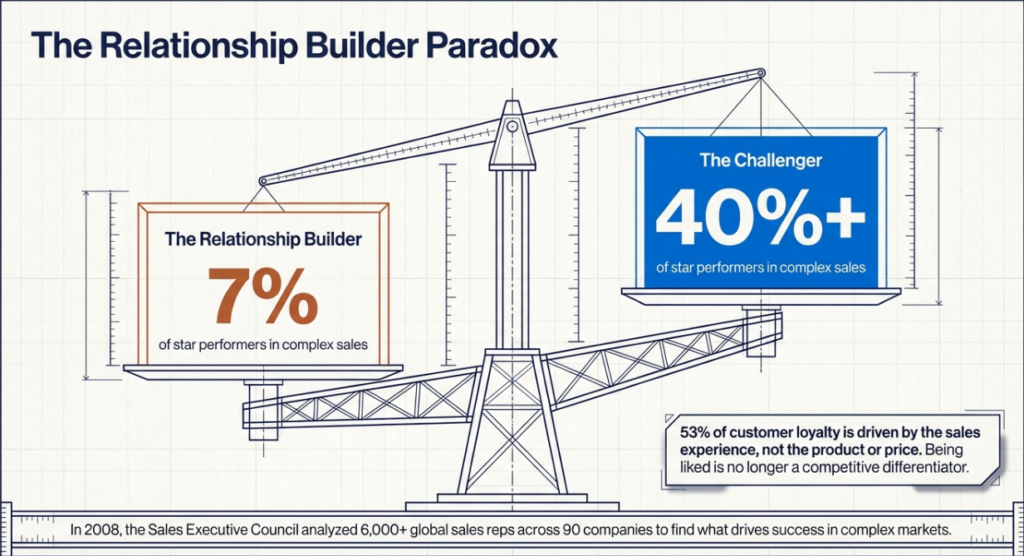
Here’s the kicker: relationship builders are actually the *least* likely to be star performers in complex B2B sales. Surprised? You’re not alone. The data is clear—Challengers dominate, especially when the stakes are high and the deals are complicated.
The Numbers That Make You Rethink Everything
- 40% of star performers are Challengers
- Only 7% of star performers are Relationship Builders
- 53% of customer loyalty is driven by the sales experience—not product or price
- 6,000+ reps, 90+ companies, global study
If you’re still clinging to the “be their friend” playbook, it might be time to put it on the shelf.
How Did We Get Here? The Research Story
Let’s rewind to 2008. The world’s in financial chaos, and sales teams everywhere are scrambling. Some are thriving, others are barely treading water. The Sales Executive Council (now part of Gartner) wanted to know: what separates the winners from the also-rans?
They didn’t just ask a few folks at a conference. We’re talking 6,000+ reps, 90+ companies, across continents and industries. They looked at hard numbers, customer feedback, manager reviews, and self-assessments. The expectation? Relationship builders would come out on top. The reality? Not even close.
When the dust settled, Challengers were the clear winners. Relationship builders? Dead last among star performers in complex sales. That’s not just a plot twist—it’s a whole new genre.
Meet the Five Sales Rep Profiles (And Guess Who Wins)
You know how every sales team has its cast of characters? The research boiled it down to five main types. Let’s break them down—see if you recognize yourself or your colleagues.
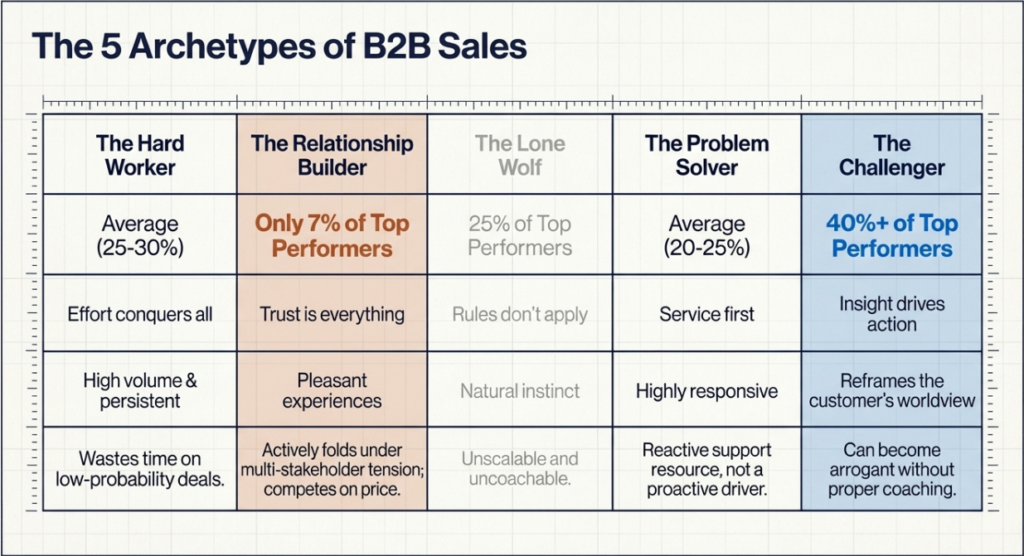
1. The Challenger
- What they do: They teach, tailor, and take control. They’re not afraid to push back, debate, or reframe a customer’s thinking.
- Strengths: They bring new insights, create value, and drive consensus. They thrive in tough markets.
- Weaknesses: Can come off as arrogant if not careful. Needs training to avoid being a “know-it-all.”
- Performance: 40% of star performers.
2. The Hard Worker
- What they do: Hustle, hustle, hustle. First in, last out. Never gives up.
- Strengths: Reliable, persistent, great for maintaining accounts.
- Weaknesses: Can burn out, sometimes works hard on the wrong deals.
- Performance: Average.
3. The Relationship Builder
- What they do: Focus on rapport, avoid conflict, prioritize customer happiness.
- Strengths: Great for simple sales, keeps customers happy.
- Weaknesses: Struggles in complex deals, often competes on price, can’t stand out.
- Performance: Only 7% of stars. Ouch.
4. The Lone Wolf
- What they do: March to their own drum. Ignore the rules, but sometimes get big results.
- Strengths: Talented, adaptable.
- Weaknesses: Impossible to manage, can’t scale their success.
- Performance: 25% of stars, but not a model you can build a team around.
5. The Problem Solver
- What they do: Always there to fix issues, highly responsive.
- Strengths: Great customer service, technical know-how.
- Weaknesses: Reactive, not proactive. Rarely challenges the customer.
- Performance: Average.
Quick Visual: Who’s Who?
- Relationship Builder: 27%
- Hard Worker: 22%
- Problem Solver: 19%
- Lone Wolf: 12%
- Challenger: 20%
But among star performers? Challengers and Lone Wolves take the lion’s share.
The Challenger’s Secret Sauce: Three Skills That Change the Game
So what makes a Challenger tick? It’s not magic, and it’s not just personality. It’s three teachable skills:
1. Teach for Differentiation
Challengers don’t just ask what keeps the customer up at night—they tell them what *should* be keeping them up. They bring insights the customer hasn’t considered, often reframing the problem entirely.
- Don’t ask—tell: Lead with insight, not questions.
- Unique perspectives: Share trends, risks, or opportunities others miss.
- Connect to your strengths: Make sure your insight ties back to what you do best.
2. Tailor for Resonance
One message does *not* fit all. Challengers customize their pitch for each stakeholder—CEO, CFO, CTO, HR, end users. They speak the language of each decision-maker.
- Map the committee: Know who’s in the room (or behind the scenes).
- Role-specific messages: Address what matters to each person.
- Industry context: Show you get their world.
3. Take Control (Without Being a Jerk)
Challengers guide the process. They’re comfortable talking money, pushing for next steps, and standing firm on value. But they’re not bulldozers—they use constructive tension, not conflict.
- Discuss price early: Don’t shy away from the money talk.
- Keep momentum: Always push for the next step.
- Don’t discount just to close: Stand by your value.
The Six-Step Teaching Pitch: How Challengers Win the Conversation
Here’s where the Challenger approach really shines—a structured conversation that flips the script and gets customers leaning in.
- STEP 1: The Warm-Up Show you’ve done your homework. Share what you know about their business and industry. Build credibility fast.
- STEP 2: The Reframe Challenge their assumptions. Offer a new perspective that makes them rethink the problem.
- STEP 3: Rational Drowning Hit them with data. Show the problem is bigger (or different) than they realized. Use numbers, benchmarks, charts—whatever makes it real.
- STEP 4: Emotional Impact Make it personal. How does this problem affect their team, their goals, their reputation? Create urgency.
- STEP 5: A New Way Before you pitch your solution, show what’s possible. Paint a picture of a better approach.
- STEP 6: Your Solution Now, and only now, introduce your product or service as the logical answer. By this point, they’re ready to listen.
Why Relationship Building Isn’t Enough (And Might Even Hurt You)
This is the part that makes some sales veterans squirm. For decades, we’ve been told to build relationships, avoid tension, and be the “nice guy.” But in complex B2B sales, that’s a recipe for being forgettable—or worse, for losing on price.
The Relationship Builder Paradox
- Everyone builds relationships: It’s not a differentiator.
- Buyers have too many “friends”: You’re not the only one they like.
- Being liked doesn’t solve business problems: Value trumps likability.
- Without unique value, price wins: And that’s a race to the bottom.
What Do Customers Actually Want?
- Unique perspectives (82%)
- Help navigating alternatives (78%)
- Advice and education (76%)
- Help avoiding problems (74%)
- Something new about their business (71%)
- Personal relationships (53%)See the pattern? Relationships matter, but they’re not the main event.
Taking Control Without Being Aggressive: The Art of Assertiveness
Let’s clear something up: taking control doesn’t mean steamrolling your customer. It’s about guiding, not dominating.
- Assertive: Confident, guides the process, creates healthy tension.1
- Aggressive: Demanding, creates conflict, ignores the customer’s input.1
Customers are drowning in information. They want someone to lead, not just nod along. Avoiding tension leads to stalled deals and endless “let me think about it” responses.
Techniques:
- Prescriptive close: “Here’s what needs to happen next…”
- Timeline push: “To meet your Q4 goals, we need to start by October 1st.”
- Value stand: “Reducing scope will eliminate the ROI you’re looking for.”
- Access leverage: “I’ll bring in our technical team once we have alignment on the business case.”
Building Consensus: Herding Cats, Challenger-Style
If you’ve ever tried to close a big B2B deal, you know it’s rarely one person’s call. There’s a whole cast—CFO, CTO, HR, end users, IT, and sometimes the office dog (okay, maybe not the dog, but you get the idea).
- Average decision-makers: 6-10 per deal
- Each has different priorities: ROI, risk, usability, integration, etc.
How Challengers Build Consensus
- Identify all stakeholders early—don’t get blindsided.
- Understand what matters to each person.
- Create a unified story everyone can buy into.
- Equip your champion to sell internally.
- Address objections before they become roadblocks.
Implementation & Training: Turning Theory Into Results
Here’s the good news: Challenger skills aren’t just for “naturals.” They can be taught, practiced, and mastered. But it takes commitment—from reps, managers, and leadership.
Four Phases of Challenger Training
- Foundation: Learn the profiles, core skills, and teaching pitch.
- Skill Development: Practice, role-play, develop insights.
- Application: Real customer conversations, manager feedback.
- Mastery: Advanced techniques, peer learning, continuous improvement.
The Manager’s Role
Managers are the glue. They reinforce skills, share insights, and coach in real time. Without manager buy-in, Challenger programs fizzle.
Common challenges:
- Reps resist change? Show them the data.
- Managers don’t reinforce? Train them first.
- Insights get stale? Refresh regularly.
- Skills fade? Keep coaching.
Case Studies: Challenger in the Real World
Cars.com
- Challenge: Struggling with complex deals.
- Solution: Trained 150+ reps, built industry insights, manager coaching.
- Results: 20% higher win rates, 15% bigger deals, faster sales cycles.
CEB (Now Gartner)
- Challenge: Prove the model works internally.
- Solution: Trained their own team, built teaching pitches.
- Results: Challenger reps outperformed by 23%, higher customer satisfaction.
Enterprise Software Company
- Challenge: Competing on price.
- Solution: Developed unique insights, tailored messages.
- Results: 35% less discounting, 28% higher win rates, 22% shorter cycles.
Common Misconceptions: Let’s Set the Record Straight
- “Challengers are arrogant.” Not if they’re trained. Confidence is not arrogance.
- “This only works in tech.” Nope—works across industries: finance, healthcare, manufacturing, services.
- “Customers will hate this.” Actually, they prefer it. They want guidance.
- “You have to be naturally aggressive.” Assertiveness is a skill, not a personality trait.
- “This replaces all other sales methods.” It complements others—think of it as the missing piece.
Key Takeaways & Action Items
For Sales Leaders
- Assess your team’s profiles.
- Develop teaching insights.
- Train managers first.
- Roll out rep training.
- Implement ongoing coaching.
For Sales Reps
- Figure out your profile.
- Master the 6-step teaching pitch.
- Build industry insights.
- Practice taking control.
- Get regular feedback.
For Organizations
- Commit to the methodology.
- Invest in training.
- Build an insight generation process.
- Track results.
- Reinforce with incentives.
The Challenger Checklist
Before every meeting, ask yourself:
- Do I have a unique insight to teach?
- Is my message tailored for this stakeholder?
- Am I ready to guide the conversation?
- Do I have data to back up my claims?
- Have I planned my teaching pitch?
- Do I know all the players?
- Am I comfortable talking money?
Final Thoughts: It’s Not What You Sell—It’s How You Sell
If you take one thing away, let it be this: in complex B2B sales, being liked isn’t enough. Customers want to be challenged, taught, and guided. The Challenger Sale isn’t about being pushy—it’s about being valuable.
What Next?
- Measure, learn, and keep improving.
- Read the full book for the deep dive.
- Assess your team’s profiles.
- Build your teaching pitch.
- Train your managers.
Glossary of Key Terms
| Term | Definition |
| Assertive | A communication style where the rep is confident in their value, guides the process, and stands firm on principles without being demanding or disrespectful. |
| Challenger | A sales profile characterized by the ability to teach customers unique perspectives, debate customer thinking, and take control of the sales conversation. |
| Commercial Teaching | A teaching approach that leads with insights designed to show customers how to save or make money, ultimately connecting those insights to the supplier’s unique strengths. |
| Constructive Tension | The pressure created when a salesperson challenges a customer’s assumptions or pushes for a decision; used to accelerate the sales process and drive change. |
| Economic Buyer | A stakeholder typically concerned with high-level financial outcomes, such as ROI and cost savings, who must be tailored to during the consensus-building process. |
| Hard Worker | A sales profile characterized by high self-motivation, persistence, and a willingness to go the extra mile, generally resulting in average performance. |
| Lone Wolf | A high-performing but difficult-to-manage sales profile that operates independently and follows its own instincts rather than company processes. |
| Problem Solver | A sales profile focused on being highly responsive and solving immediate customer service issues, often acting more like a support resource than a salesperson. |
| Rational Drowning | The third step of the Teaching Pitch where the rep uses data and charts to prove the scale of the customer’s problem. |
| Relationship Builder | The lowest-performing profile in complex sales, characterized by a focus on avoiding conflict and prioritizing customer satisfaction over challenging the status quo. |
| The Reframe | The second step of the Teaching Pitch where the salesperson introduces a new perspective that challenges the customer’s assumptions about their business. |
| Take Control | The skill of confidently guiding the sales process, discussing money early, and maintaining momentum despite customer pushback. |